residential AC maintenance Sandy
<!DOCTYPE html>
How Canyon Winds Impact Your Outdoor Condenser Performance
How Canyon Winds Impact Your Outdoor Condenser Performance
High-desert airflow, altitude-thin air, and Wasatch granite dust create a unique environment for condensers in Sandy, UT. This article explains how canyon winds shape outdoor unit performance and what targeted AC maintenance in Sandy, UT does to stabilize efficiency, protect components, and keep homes comfortable from Dimple Dell to Hidden Valley.
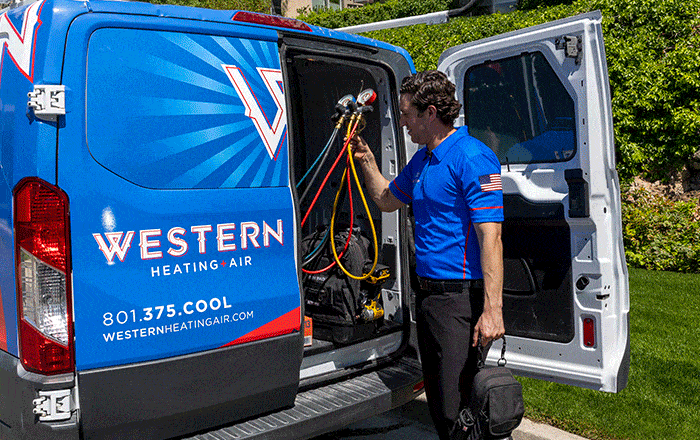
Why Sandy’s canyon winds matter for condensers
Sandy sits along the Wasatch Front at roughly 4,400 feet. Little Cottonwood Canyon opens directly into neighborhoods east of Wasatch Boulevard. Summertime brings gust fronts and drainage flows that intensify in the afternoon and at night. Those canyon winds carry granite particulates that locals call Wasatch dust. The mix of gusty crosswinds, thin air, and abrasive dust works against normal condenser airflow and causes measurable drops in cooling performance.
In practical terms, crosswinds can disrupt the fan’s intended intake and discharge pattern. Gusts recirculate hot exhaust air back across the coil face. The coil then rejects less heat. Head pressure climbs. The compressor runs longer and pulls more amperage. Add dust-packed fins and the effect compounds. Utility bills rise, comfort drops, and electrical parts see stress they were never meant to handle for long stretches.
How an outdoor condenser moves heat, and how wind scrambles it
A condenser’s job is precise. The fan pulls ambient air across the coil. Refrigerant rejects heat into that moving airstream. The hot air discharges vertically through the top grill on most modern units. That discharge column must stay clean, vertical, and undisturbed for the coil to cool the refrigerant at the intended condensing temperature.
Canyon winds push laterally across the fan shroud and coil. Strong crosswinds cause several technical problems at once:
First, wind shear tilts the discharge column. Hot discharge air folds over the cabinet rim and re-enters the coil face. This recirculation raises the entering air temperature. The condensing temperature rises and the compressor runs at a higher compression ratio.
Second, side gusts create uneven static pressure across the coil. A fan blade expects uniform intake around the perimeter. If two sides get starved while the wind forces air through the opposite side, total airflow drops below design. The fan curve falls off. The motor draws more amps to hold speed, and bearings see side-loading.
Third, wind-driven dust loads the fins. Granite particulates wedge into the microchannel or fin-and-tube matrix. Airflow resistance increases. The coil skin temperature runs hotter. On R-410A systems, that can push head pressure 20 to 60 psi higher during a hot July afternoon compared to a clean, calm-day baseline. The compressor runs hotter and oil returns less predictably in some scroll platforms.
Altitude, thin air, and the fan’s real workload
At 4,400 feet the air density in Sandy is lower than sea level. Lower density reduces mass airflow for the same fan speed. The condenser therefore rejects less heat per revolution than the nameplate assumptions suggest. Manufacturers publish performance tables that reflect this, but very few backyards match lab conditions. Add a constant crosswind and the fan is fighting thin air and turbulence at the same time.
That drives the need for high-altitude calibration. A technician familiar with Sandy will verify the condenser fan amperage, the capacitor’s microfarad output, and the fan RPM against expected values. They will also consider a motor speed setting or ECM profile if the unit supports it. On systems with communicating boards, a service mode can raise fan speed during peak heat events to offset some density loss, provided the compressor and coil can benefit from that extra airflow without noise or vibration issues.
How Wasatch dust and granite particulates change coil physics
Wasatch dust is sharp and angular. Once it embeds, it bridges between fins like a tiny web. Light fouling raises static pressure across the coil and forces the fan to work harder. Heavier fouling acts like insulation. It raises the coil surface temperature and erodes heat transfer. The consequence shows up as higher condensing temperature and head pressure. That shifts the refrigerant saturation point and makes the superheat and subcool targets harder to hit.
Technicians see this in Sandy during mid-season tune-ups. A coil that looks lightly dusty can still cost a homeowner 8 to 15 percent in capacity and efficiency. Power washing with the right nozzle spacing and angle restores fin exposure. Chemical cleaners must be selected carefully to avoid fin etching on microchannel coils. After cleaning, many homeowners notice shorter run times and a quieter fan, even without changing any controls.
Electrical components under wind stress
Gusts by themselves do not break parts, but they force operating conditions that strain them. Long cycles at high head pressure raise compressor winding temperature. That heat migrates to terminals and the contactor. Fast on-off cycling during intermittent gusts can pound a start capacitor. When a capacitor is already weak, the added load tips it over during the first hot stretch in July.
In Sandy’s arid climate, lubricants dry faster. Outdoor fan bearings lose their protective film. With grit in the airstream, fan hubs get noisy. As friction grows, amp draw edges up. Marginal capacitors then fail under the extra torque demand. Western Heating, Air & Plumbing techs see the pattern in State Street corridor rooftops and in Hidden Valley backyards every summer: wind, grit, and dry bearings create a feedback loop that ends with a fan motor or capacitor replacement during a heat wave.
Siting, clearances, and wind baffling in Sandy neighborhoods
Placement helps. A condenser should sit level on a stable pad, clear of roof runoff, and at least 18 inches from obstructions on all sides. Many backyards in 84092 and 84093 back up to slopes that funnel wind. A short privacy screen can act as a wind baffle if it preserves intake clearance. Avoid solid enclosures that trap hot discharge air. Slatted fencing aligned to break crosswinds works better. Keep plantings low and at least the manufacturer’s recommended distance from the coil face, usually 18 to 24 inches for standard cabinets.
Units near Little Cottonwood Canyon see heavier gusts. A technician may suggest rotating the cabinet slightly to reduce direct crosswind through the coil face or swapping to a top-discharge fan shroud with improved lip geometry. On a few platforms, a factory wind baffle kit exists. Where none exists, field-built screens can help, but they must not void UL spacing or manufacturer clearance limits.
Refrigerant charge at altitude: what R-410A looks like on a gusty day
R-410A systems in Sandy often run with lower mass flow due to thin air across the coil and can show deceptive head pressures on a windy afternoon. If a tech chases pressures without watching entering air temperature, coil cleanliness, and wind effects, they may add refrigerant to hit a sea-level impression of normal. That leads to overcharge. The right method is to control conditions as much as possible, verify coil cleanliness, measure subcool and superheat, and reference manufacturer altitude-correction data. Western’s team uses digital gauges and probes to stabilize readings and cross-check against the equipment’s engineering data for the 4,400-foot elevation.
A clean coil and steady intake make readings trustworthy. That is why the maintenance sequence matters: clean first, verify airflow second, then dial in charge. In thin, gusty air, patience during stabilization avoids errors that cost energy all summer.
Inside the home: blower motor settings and static pressure at 4,400 feet
Condenser performance ties to indoor airflow. At altitude, verify blower tap or ECM profile against target CFM per ton. Sandy’s arid climate dries seals and can alter duct leakage over time. High static pressure at the blower chokes coil capacity and raises compressor work. A tuned blower curve reduces latent and sensible losses and stabilizes the system when the outdoor unit is fighting wind. During AC maintenance in Sandy, UT, Western’s technicians measure static pressure, confirm blower speed, and document CFM. They also lubricate bearings where the design includes ports, which reduces friction that tends to escalate in low-humidity homes.
Dual-fuel and heat pump changeover strategy for Wasatch swings
Hidden Valley and Alta View homes with hybrid heat pump systems benefit from a tested changeover temperature. Rapid evening cool-downs off the canyon can trick controls. A proper changeover point keeps the system on the most efficient heat source for the hour. During a seasonal cooling inspection, a Western tech verifies the thermostat logic, outdoor sensor accuracy, and staging parameters. They also perform a heat exchanger safety check for dual-fuel furnaces while on site. This protects warranty standing and sets the equipment up for shoulder-season reliability.
What a wind-aware tune-up looks like
Western Heating, Air & Plumbing’s tune-ups in Sandy include steps built for canyon winds and Wasatch dust. The team performs condenser coil power washing with controlled pressure to open fin passages without bending them. They audit electrical components with a focus on contactors, capacitors, relays, and cooling fan amp draw. They verify R-410A charge using both subcool and superheat under as steady a wind condition as possible. They check blower motor lubrication on applicable models, confirm static pressure, and adjust speed for altitude needs. For homes with gas equipment on site, they are RMGA certified to review combustion safety. They complete amp draw testing to spot motors drifting out of spec before failure. Finally, they log a 2026 SEER2 compliance check to align field conditions with rated performance.
Brand experience matters on this terrain. The team services Lennox, Carrier, Trane, Rheem, Goodman, Bryant, York, and Mitsubishi mini-splits across Sandy City Center, Dimple Dell, the State Street corridor, and neighborhoods along Little Cottonwood Canyon. Documentation supports warranty validation across major manufacturers and helps maintain eligibility for parts coverage when failures occur.
AC Maintenance Sandy, UT | Precision HVAC Tune-Ups
Homeowners across 84070, 84090, 84091, 84092, 84093, and 84094 face the same wind and dust pattern. A precision HVAC tune-up tailored to the Wasatch Front cuts wasted energy and stabilizes comfort under gusty conditions. For many homes, Rocky Mountain Power bills drop after a proper cleaning and calibration. The difference is clear during July heat waves when a tuned system holds setpoint without extended runtimes.
A real example from the Hidden Valley area
A Hidden Valley homeowner with a three-ton R-410A system called about long cycles and outdoor noise on windy afternoons. The condenser sat just 12 inches from a solid fence that paralleled the prevailing wind from Little Cottonwood. The fins showed light dusting but clogged more deeply than the surface suggested. The fan capacitor tested weak by 15 percent. Head pressure during a 94-degree afternoon hovered 45 to 55 psi above expected for the coil design and airflow.
Western’s technician power washed the coil, replaced the capacitor to match nameplate microfarads, and rotated the condenser 20 degrees to reduce direct crosswind on the coil face. They added a slatted wind screen that preserved a 24-inch intake clearance and raised the discharge plane above the top fence line. They then verified charge by subcool and tuned the blower ECM for the calculated CFM per ton at altitude. The result was a seven-minute shorter runtime per cycle and a noticeable drop in fan noise. The homeowner reported a 10 to 12 percent reduction on the next Rocky Mountain Power bill compared to the same month in the prior year with similar temperatures.
Signs wind is undermining condenser performance
Homeowners often spot patterns before parts fail. The following short list reflects field notes across Sandy and neighboring Salt Lake County communities.
- Hot air felt near the coil face on a windy day, suggesting discharge recirculation
- Audible fan pitch changes during gusts, paired with light cabinet vibration
- Visible dust banding across fins where wind packs debris into one quadrant
- Breaker trips or hard starts on the first hot afternoons of July
- Longer cool-down times in the evening when canyon winds increase
Any of these justify a targeted inspection. Many resolve with cleaning, a small placement change, or a minor part before it fails under load.
Maintenance, warranties, and SEER2 performance
Manufacturers such as Lennox, Carrier, Trane, and others require documented annual maintenance to keep parts warranties valid. That documentation matters when a contactor welds shut or a compressor fails under warranty terms. Western provides digital reports with photos, readings, and a parts status summary. Those records also help track SEER2-related performance year over year. While the rating is a lab metric, a clean coil, stable airflow, and correct charge keep field efficiency close to design despite altitude and wind.
For commercial properties along State Street or mixed-use buildings near Sandy City Center, the same wind issues scale up. Rooftop units see higher wind speeds and more abrasive dust. Western’s commercial team adapts cleaning methods, verifies economizer operation if present, and validates that condenser fan cycling is not creating off-hour nuisance trips during gusts.
Safety and dual-fuel checks during a summer tune-up
Dual-fuel homes in Dimple Dell and Alta View benefit from a quick heat exchanger safety review while technicians are on site. Heat cracks seldom announce themselves during cooling season, yet a five-minute test with RMGA protocol protects the home before fall. Western’s NATE-certified and EPA Section 608 certified technicians roll these checks into a maintenance visit so one appointment covers both cooling performance and seasonal safety.
Homeowner tactics for wind and dust mitigation
Simple actions reduce strain between professional tune-ups. They do not replace a full inspection, but they help stabilize airflow and keep grit off sensitive parts.
- Rinse grass clippings and light dust from the coil with a garden hose, spraying outward from the inside if cabinet design allows
- Trim shrubs to maintain at least 18 to 24 inches of clear space around the unit
- Realign or replace loose top grilles and cabinet panels so gusts do not whistle or vibrate through gaps
- Check that the unit sits level on a stable pad so oil returns correctly and the fan loads evenly
- Use a slatted wind screen a few feet away to break direct crosswinds without boxing in the unit
If anything more than light rinsing is required, let a pro handle it. Power washing with the wrong tip distance can fold fins and cut capacity further. A technician will choose the right pressure and cleaning chemistry for the coil type.
How Western tunes for Sandy’s microclimate
Western Heating, Air & Plumbing has tuned condensers on windy ridgelines near the Little Cottonwood mouth and across quieter lots west of 700 East. The company’s Sandy protocol focuses on:
Condenser coil power cleaning to remove Wasatch dust. Electrical component audits that catch capacitor failure before the heat spikes. Refrigerant level verification for R-410A that accounts for altitude and wind-stabilized readings. Blower motor lubrication and static pressure checks to deliver the right CFM per ton indoors. Amp draw testing on condenser and blower motors to catch early friction or winding fatigue. Changeover verification for hybrid heat pump systems and a heat exchanger safety check for dual-fuel equipment. A 2026 SEER2 compliance check to align field practices with current standards.
This approach keeps performance predictable during July heat waves and windy evenings. It also supports warranty validation, which protects homeowners from surprise parts costs.
Rocky Mountain Power savings and practical expectations
A clean, wind-aware condenser cannot fix bad duct design or leaky homes, but it does remove a major source of waste. Many Sandy homes see a reduction in summer kWh use after a proper tune-up and minor airflow corrections. Typical savings run in the single to low double digits depending on starting condition. The bigger win is stable comfort. Thermostats hold setpoint longer. Noise drops. Breaker trips fade away.
For estates near Hidden Valley where larger systems serve zoned interiors, wind baffles and coil hygiene extend equipment life. For smaller homes near Sandy City Center, capacitor and contactor health often make the difference during the first big heat wave. The same applies to mini-split condensers from Mitsubishi mounted on east walls that take direct gusts. Placement tweaks and clearances matter as much as cleaning those slim coils.
Service coverage across Sandy
Western services AC maintenance across Sandy ZIP codes 84070, 84090, 84091, 84092, 84093, and 84094. The team knows the wind corridors near Little Cottonwood Canyon, the dust pockets around construction along the State Street corridor, and the calmer microclimates near Dimple Dell. That local context shortens diagnostic time and points the tune-up toward root causes instead of symptoms.
Brands and certifications that fit the terrain
Western maintains Lennox, Carrier, Trane, Rheem, Goodman, Bryant, York, and Mitsubishi mini-splits across Salt Lake County. Technicians hold NATE certification and EPA Section 608 credentials for refrigerant handling. RMGA certification supports safe gas checks on dual-fuel systems during the same visit. Combined, those credentials back the company’s altitude-aware and wind-aware methods with recognized industry standards.
What to schedule and when
Spring and early summer are the best times to schedule AC maintenance in Sandy, UT. Winds pick up and dust loads increase as snowmelt recedes in Little Cottonwood. A seasonal cooling inspection before July controls the variables. Clean coils, confirmed R-410A charge, healthy capacitors, and verified airflow keep systems steady during heat spikes. For homes that missed spring service, a mid-season tune-up still helps. Western offers annual maintenance plans that include priority service status during peak heat events. Those plans also keep professional maintenance documentation on file for warranty retention.
What success looks like after a tune-up
After a proper tune-up in Sandy, discharge air rises in a tight, vertical column even on a breezy day. The coil face runs evenly cool to the touch when compared across quadrants. Fan pitch is stable with no flutter on gusts. The compressor draws within a few percent of expected running amps. Subcool and superheat fall in line with the manufacturer chart adjusted for conditions. Indoors, vents deliver steady, cool air without the blower surging against static. These are the signs of an outdoor unit that rejects heat cleanly despite canyon winds.
Why professional documentation protects value
Manufacturers routinely ask for maintenance records during parts claims. Western’s digital reports include coil condition photos, capacitor values in microfarads, motor amp draws, static pressure readings, and charge metrics. That record anchors warranty validation for brands such as Lennox, Carrier, Trane, Rheem, Goodman, Bryant, York, and Mitsubishi. It also supports resale value. Buyers appreciate service history, especially in mountain-adjacent neighborhoods where wind exposure is higher.
Engineering details that pay off in Sandy
Several small engineering choices make a large difference under wind load. A properly sized run capacitor holds fan torque through gusts and reduces stalling. A balanced fan blade with the correct pitch maintains airflow under moderate crosswind. A cabinet that sits one to two inches higher than surrounding grade reduces ground-effect recirculation and keeps grass clippings out of the coil base. On systems that permit it, a control setting to delay the indoor blower at start by 30 to 60 seconds allows the outdoor coil to stabilize pressure before full indoor airflow. These additions show up as smoother starts and fewer nuisance noise complaints.
Western’s “Sandy Maintenance” protocol in context
The protocol is built around the Wasatch Front’s high-altitude desert environment. It targets wind disruption, dust loading, and electrical stress specific to Sandy. The steps include multi-point precision inspection, condenser coil power cleaning, refrigerant charge verification for R-410A, blower assembly lubrication, electrical component audits, amp draw testing, and changeover verification for hybrid systems. A heat exchanger safety check for dual-fuel systems and a 2026 SEER2 compliance check close the loop. The result is a tuned system that stands up to Little Cottonwood winds and runs near rated efficiency in thin, arid air.
When replacement discussions begin
Maintenance extends life, but every unit reaches a point where parts stack up. If a condenser faces constant wind recirculation that cannot be mitigated with screens or placement, it may require a different cabinet style or a matched system upgrade. Western compares repair costs against remaining life, energy use, and site conditions. In many Sandy homes, a new condenser with improved fan design, ECM control, and better discharge geometry pays back faster than expected once wind and dust penalties are counted. That decision is always weighed with real numbers from the site.
AC maintenance in Sandy, UT with clear local intent
Every reference point in this article comes from Sandy and broader Salt Lake County conditions. From the State Street corridor to the foothills above 1300 East, canyon winds and Wasatch dust shape condenser behavior. That is why generic tune-ups fall short here. The maintenance plan must be local, altitude-aware, and wind-aware. Western Heating, Air & Plumbing delivers that approach with NATE, RMGA, and EPA Section 608 credentials and decades of service on the Wasatch Front.
Get answers before the next gust front
If the outdoor unit runs louder on windy afternoons, or if evening cool-downs take longer near Little Cottonwood, the condenser is likely fighting recirculation and dust. A focused tune-up restores airflow, stabilizes charge, and protects electrical parts before the July surge. The visit takes about 60 to 90 minutes in most homes and includes a digital report suitable for warranty retention. For multi-system estates near Hidden Valley or commercial addresses along State Street, Western coordinates service to minimize downtime.
Western Heating, Air & Plumbing provides HVAC and plumbing services for homeowners and businesses across Sandy and the surrounding Utah communities. Since 1995, our team has handled heating and cooling installation, repair, and upkeep, along with ductwork, water heaters, drains, and general plumbing needs. We offer dependable service, honest guidance, and emergency support when problems can’t wait. As a family-operated company, we work to keep your space comfortable, safe, and running smoothly—backed by thousands of positive reviews from satisfied customers.
Western Heating, Air & Plumbing
9192 S 300 W
Sandy,
UT
84070,
USA
231 E 400 S Unit 104C
Salt Lake City,
UT
84111,
USA
Phone: (385) 233-9556
Website: https://westernheatingair.com/, Furnace Services
Social Media:
Instagram |
Facebook |
BBB
Map: View on Google Maps